
Gynecomastia vs. Chest Fat: How to Tell the Difference (Pseudogynecomastia)
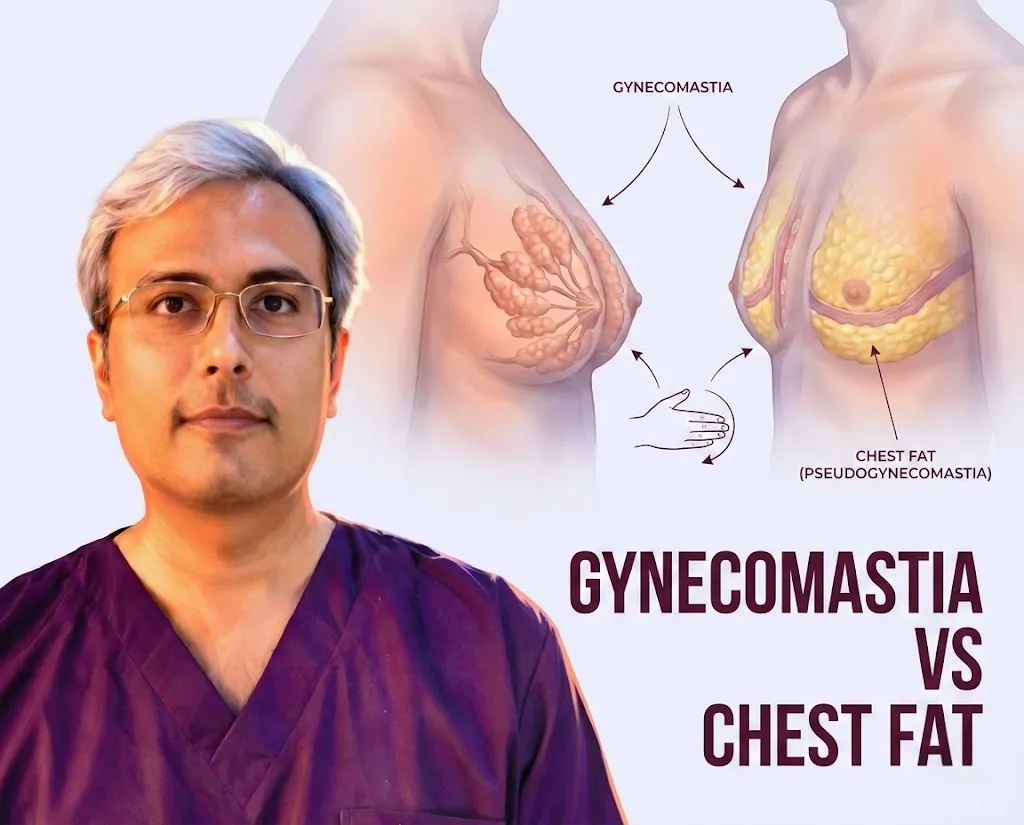
One of the most frustrating experiences for men working on their physique is seeing results everywhere except the chest. You might be hitting the gym, dialing in your diet, and losing weight, yet the fullness in your chest remains. This leads to a common and confusing question: Do I have gynecomastia, or is it just stubborn chest fat?
Understanding this distinction is critical because the treatment for each condition is entirely different. While chest fat can often be reduced with lifestyle changes, true gynecomastia involves glandular tissue that no amount of bench pressing will remove.
In this guide, we will break down the differences between true gynecomastia and pseudogynecomastia (false gynecomastia) and help you perform a simple self-check at home.
Defining Pseudogynecomastia
To understand what you are dealing with, we first need to define the two main culprits behind male breast enlargement: gland and fat.
What is False Gynecomastia?
Pseudogynecomastia, often called “false gynecomastia,” is a condition where the male breast enlarges solely due to an accumulation of adipose (fatty) tissue. Unlike true gynecomastia, there is no proliferation of the breast gland itself. It is simply a localized deposit of fat, similar to what you might carry on your stomach or flanks.
The Role of Obesity and Body Fat Percentage
Pseudogynecomastia is most commonly associated with being overweight or obese. As your overall body fat percentage increases, your body stores fat in various “depots.” For many men, the chest is a primary storage site. However, it is important to note that even men with a relatively healthy weight can struggle with this if they have a genetic predisposition to store fat in the chest area.
Why Chest Fat is Stubborn
You may wonder why the fat on your arms or legs disappears quickly, but your chest remains soft. Chest fat is notoriously stubborn because of its cellular structure. Fat cells in this area often have a higher concentration of alpha-receptors, which inhibit fat breakdown (lipolysis), making them resistant to standard weight loss efforts.
The Self-Check: The Pinch Test
The most reliable way to distinguish between fat and gland—short of an ultrasound—is a manual exam known as the Pinch Test.
How to Perform the Pinch Test at Home
- Stand in front of a mirror with your shirt off.
- Raise one arm slightly to stretch the chest muscle.
- Use the thumb and index finger of your opposite hand.
- Pinch the tissue directly underneath your nipple and areola. Do not pinch the outer chest fat; focus specifically on what is sitting behind the nipple.
Feeling for the ‘Rubber Disc’ (Gland)
If you have true gynecomastia, you will feel a distinct, firm mass behind the nipple. Patients often describe this as feeling like a rubbery disc, a grape, or even a small stone. This firm tissue is the breast gland. If you feel this hard lump, you are likely dealing with true gynecomastia. For more details on these physical sensations, you can read our guide on what gynecomastia feels like.
Recognizing Soft vs. Firm Tissue
If you perform the pinch test and feel uniform softness—similar to the feeling of your stomach fat—you are likely dealing with pseudogynecomastia. Chest fat is squishy and does not have a defined shape or hard edges. If your fingers meet no resistance and feel only soft tissue, the condition is likely fat-dominant.
Visual Differences
Even without touching the area, there are visual cues that can help you differentiate between the two conditions.
Areola Shape: Puffy vs. Flat
This is often the biggest giveaway.
- True Gynecomastia: The glandular tissue pushes directly against the nipple-areolar complex, causing the nipples to look puffy, conical, or dome-shaped. The nipple may protrude significantly even if the rest of the chest is relatively flat.
- Pseudogynecomastia: The chest may look heavy or full, but the nipple and areola usually lie flat against the skin. There is rarely that specific “puffy nipple” appearance associated with glandular growth.
Chest Contour: Round vs. Sagging
- True Gynecomastia: The breast shape tends to be rounder and perkier because the gland is firm and holds its shape.
- Pseudogynecomastia: Fat is softer and more subject to gravity. Therefore, a fatty chest often appears to sag or create folds, especially near the armpit or the lower chest crease.
Projection from the Chest Wall
Glandular tissue is dense, so it creates a projection that stands away from the chest wall. If you look at your chest from the side profile (lateral view), true gynecomastia often looks like a distinct mound sitting on top of the muscle. Chest fat tends to be more diffuse, spreading out over a larger area without a concentrated peak.
Can You Have Both?
The reality for many patients is that the situation isn’t black and white.
Mixed Gynecomastia: Gland + Fat
It is extremely common to have mixed gynecomastia, where the patient has both excess fatty tissue and an enlarged gland. In fact, this is the most frequent diagnosis we see. The fat contributes to the overall volume of the chest, while the gland contributes to the puffy nipple and the stubborn projection.
Why Weight Loss Might Expose the Gland
Many men lose a significant amount of weight hoping their chest will flatten, only to be disappointed. As the surrounding fat melts away, the glandular tissue (which does not respond to diet) becomes more visible. You might find that after weight loss, your chest is smaller overall, but the nipples look puffier than before because they are no longer “hidden” by the surrounding fat.
The ‘Skinny Fat’ Phenomenon
Men with a “skinny fat” body composition (low muscle mass, moderate body fat) are particularly prone to this mixed presentation. The lack of pectoral muscle definition makes even small amounts of gland or fat appear more prominent.
Treatment Paths for Each
Once you have a better idea of what is causing your chest enlargement, you can look at the appropriate solutions.
Liposuction for Pseudogynecomastia
If your condition is purely fat-based (pseudogynecomastia), liposuction is the gold standard treatment. Techniques like VASER liposuction can effectively break down and remove the stubborn fat cells, sculpting a flatter, more masculine chest contour. Because there is no gland to remove, no excision incision is needed.
Excision for True Gynecomastia
If you have a rubbery glandular disc, liposuction alone will not work. The gland is too dense to be sucked out through a cannula. It requires surgical excision, where the surgeon makes a small incision (usually along the border of the areola) to physically cut out and remove the glandular tissue.
When Diet and Exercise Fail
If you have tried dieting and chest workouts for months with zero change to your nipple shape, you almost certainly have a glandular component. In these cases, surgery is the only effective option. For patients with mixed gynecomastia, the best approach is often a combination of both treatments—liposuction to contour the chest and excision to remove the gland. You can learn more about these combined approaches in our article on surgical options for mixed cases.
Conclusion
Differentiating between chest fat and gynecomastia is the first step toward reclaiming your confidence. While pseudogynecomastia may respond to weight loss, true glandular gynecomastia requires professional intervention.
If you are unsure about your condition or feel that “rubbery disc” during your self-check, it is time to get a professional evaluation.
Ready to define your chest? Contact Dr. Vishal Purohit today to schedule your consultation. We can assess your condition and create a tailored plan to give you the masculine chest you deserve.
Call or WhatsApp us at: 7718183535