
Scars After Gynecomastia Surgery: Healing, Placement, and Treatments
When considering gynecomastia surgery, almost every patient has the same hesitation: “I want the flat chest, but I don’t want a chest full of scars.”
It is a valid concern. The goal of male breast reduction is to feel confident going shirtless at the beach or pool. Visible, jagged scars would defeat that purpose.
The reality is that all surgery involves incisions, and incisions leave marks. However, a skilled plastic surgeon doesn’t just cut; they hide. By placing incisions in natural skin folds and pigment transitions, the resulting scars can become virtually invisible to the naked eye once healed.
In this guide, we will explore exactly where these incisions are placed, how the healing timeline works, and what you can do—both at home and in the clinic—to ensure your scars fade into the background.
Incision Placement Strategy
The difference between a “good” result and a “great” result often comes down to incision placement. Surgeons use the natural anatomy of the male chest to camouflage their entry points.
The Camouflage of the Areola Border
For the vast majority of patients (Grade 1 and 2), the primary incision is made using the Webster Technique.
- The cut is placed along the lower hemisphere of the areola (the dark skin surrounding the nipple), exactly where the darker pigment meets the lighter chest skin.
- Once healed, this scar blends seamlessly into the natural color transition, making it difficult to spot even from a close distance.
Axillary (Armpit) Incisions for Lipo
To perform liposuction, the surgeon needs to insert a cannula (a thin tube). Instead of poking holes directly in the middle of the chest, these small incisions (3-4mm) are often hidden in the anterior axillary fold (the front of the armpit). When your arms are down, these marks are completely hidden.
Lateral Chest Incisions for Massive Weight Loss
For patients with massive weight loss or extreme skin laxity, standard incisions aren’t enough. The surgeon may need to extend the incision horizontally toward the side of the chest to remove excess skin rolls. While these scars are longer, they are positioned low to be hidden by the shadow of the pectoral muscle.
Why Surgeons Choose Specific Sites
Your surgeon isn’t just looking for the easiest access; they are balancing access (the ability to remove the gland fully) with aesthetics (keeping the scar hidden).
The Scar Maturation Process
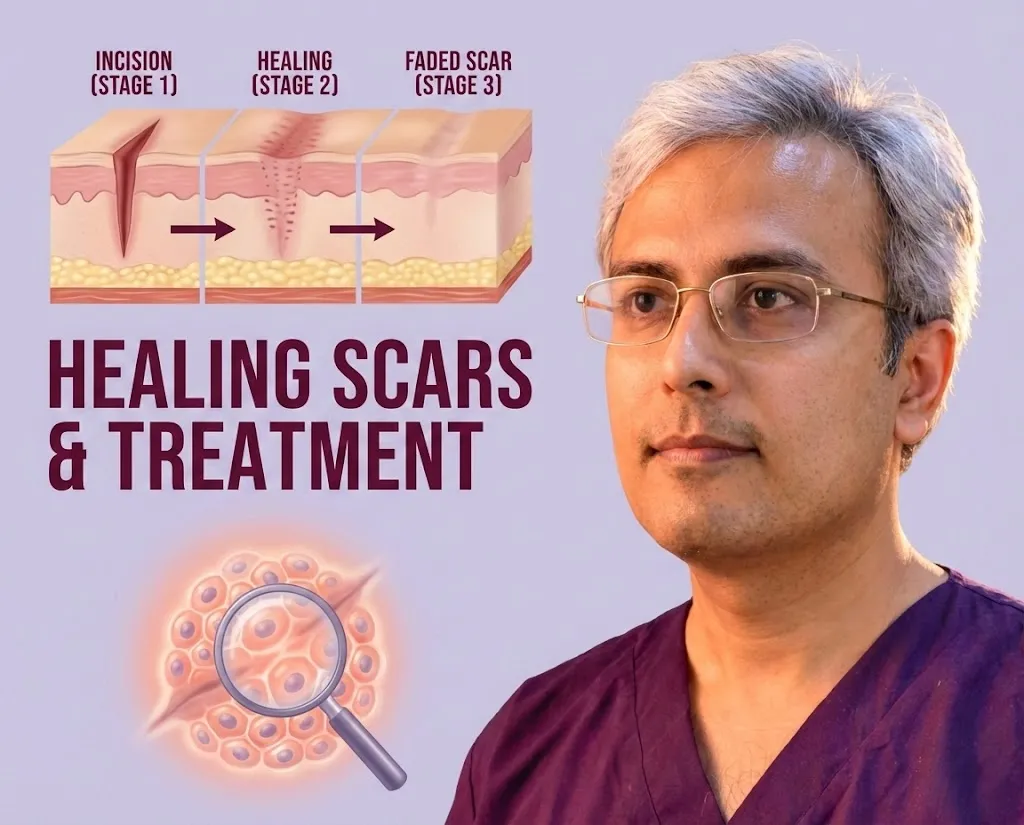
Scars do not heal overnight. In fact, they often look worse before they look better. Understanding the lifecycle of a scar can save you a lot of anxiety.
- The Inflammatory Phase (Days 1-14): The incision is sealed. It will look red, angry, and perhaps slightly raised. This is normal healing.
- The Proliferative Phase (Weeks 3-12): The body rushes collagen to the site to strengthen the wound. The scar may feel thick, ropy, or “lumpy” during this time. It will appear pink or purple.
- The Remodeling Phase (Month 3 to Year 1): This is the final settling period. The disorganized collagen aligns, the redness fades to white or silver, and the texture flattens out.
Note: A scar takes a full 12 to 18 months to mature completely. Patience is key.
Minimizing Scars at Home
You play a huge role in how your scars turn out. Once your surgeon clears you (usually after the scabs fall off), you should start a proactive scar care regimen.
-
Silicone Gel Sheets and Creams: Silicone is the gold standard in scar therapy. It hydrates the scar tissue and regulates collagen production, preventing the scar from becoming raised.
-
Recommendation: Apply silicone sheets or gel daily for at least 3 months post-op.
-
Sun Protection (UV Avoidance): Fresh scars are highly sensitive to UV rays. If you expose a pink scar to the sun, it can permanently darken (hyperpigmentation). Always apply SPF 50+ or keep your chest covered for the first year.
-
Hydration and Massage Techniques: Massaging the scar with bio-oil or vitamin E oil helps break down internal scar tissue and keeps the skin pliable. Use firm circular motions for 5-10 minutes daily.
Professional Scar Treatments
If your scars remain red or raised after 6 months, professional dermatological treatments can erase the final traces.
- Laser Resurfacing (Fractional CO2): This laser drills microscopic holes in the scar tissue, forcing the body to generate smooth, new skin. It is excellent for blending the texture of the scar with the surrounding skin.
- Microneedling: A device with tiny needles creates micro-injuries, stimulating fresh collagen. This helps to flatten scars and improve skin texture.
- Steroid Injections: If you are prone to keloids or hypertrophic scars (thick, raised scars that grow beyond the incision), your doctor can inject corticosteroids (like Kenalog) directly into the scar to melt the excess collagen and flatten it.
Worried about keloids? Read more about the genetic factors in our guide on risks of keloids.
Scars vs. Loose Skin
In severe cases of gynecomastia, patients face a difficult choice: accept a flat chest with a visible scar, or keep a sagging chest with no scar.
The Trade-off in Grade 3 & 4 Cases
For men with Grade 3 or 4 gynecomastia (large breasts with significant drooping), removing the gland alone isn’t enough—the skin will hang empty.
- To fix this, skin must be excised.
- This may require a “donut lift” (circumareolar incision) or an “anchor incision.”
- Most patients find that a thin, pale scar is a worthy trade-off for removing the appearance of female-like breasts.
Unsure if you fall into this category? Check our guide on severe grade surgery to see examples of different severity levels.
Nipple Repositioning Scars
In extreme cases, the nipple may need to be physically moved up to a more masculine position on the chest. This results in scarring around the entire perimeter of the areola, but it allows for a proper, athletic chest contour.
Conclusion
While no surgery is truly “scarless,” modern gynecomastia techniques come very close. With strategic incision placement and a solid post-op care routine, your scars can fade to faint, barely noticeable lines. Ultimately, the confidence of wearing a fitted t-shirt or walking shirtless on the beach far outweighs the presence of a tiny, hidden mark.
Concerned about scarring? Schedule a consultation with Dr. Vishal Purohit to discuss incision placement and see before-and-after photos of healed scars from previous patients.
Call or WhatsApp: +91 77181 83535