
Risks and Complications of Gynecomastia Surgery: What You Need to Know
Gynecomastia surgery is statistically one of the safest and most satisfying cosmetic procedures performed today. For thousands of men every year, it is a life-changing event that restores confidence and comfort. However, no surgery is without risk.
In the medical world, “informed consent” means you understand not just the benefits, but also the potential downsides. While serious complications are extremely rare in the hands of a board-certified specialist, minor issues can occur. Being aware of these possibilities allows you to spot them early and manage them effectively.
In this honest guide, we will break down the risks—from common temporary nuisances to rare aesthetic concerns—so you can make a fully informed decision.
Common Minor Complications
Most “complications” are actually just temporary side effects of the healing process. These are usually self-limiting and resolve within a few weeks or months.
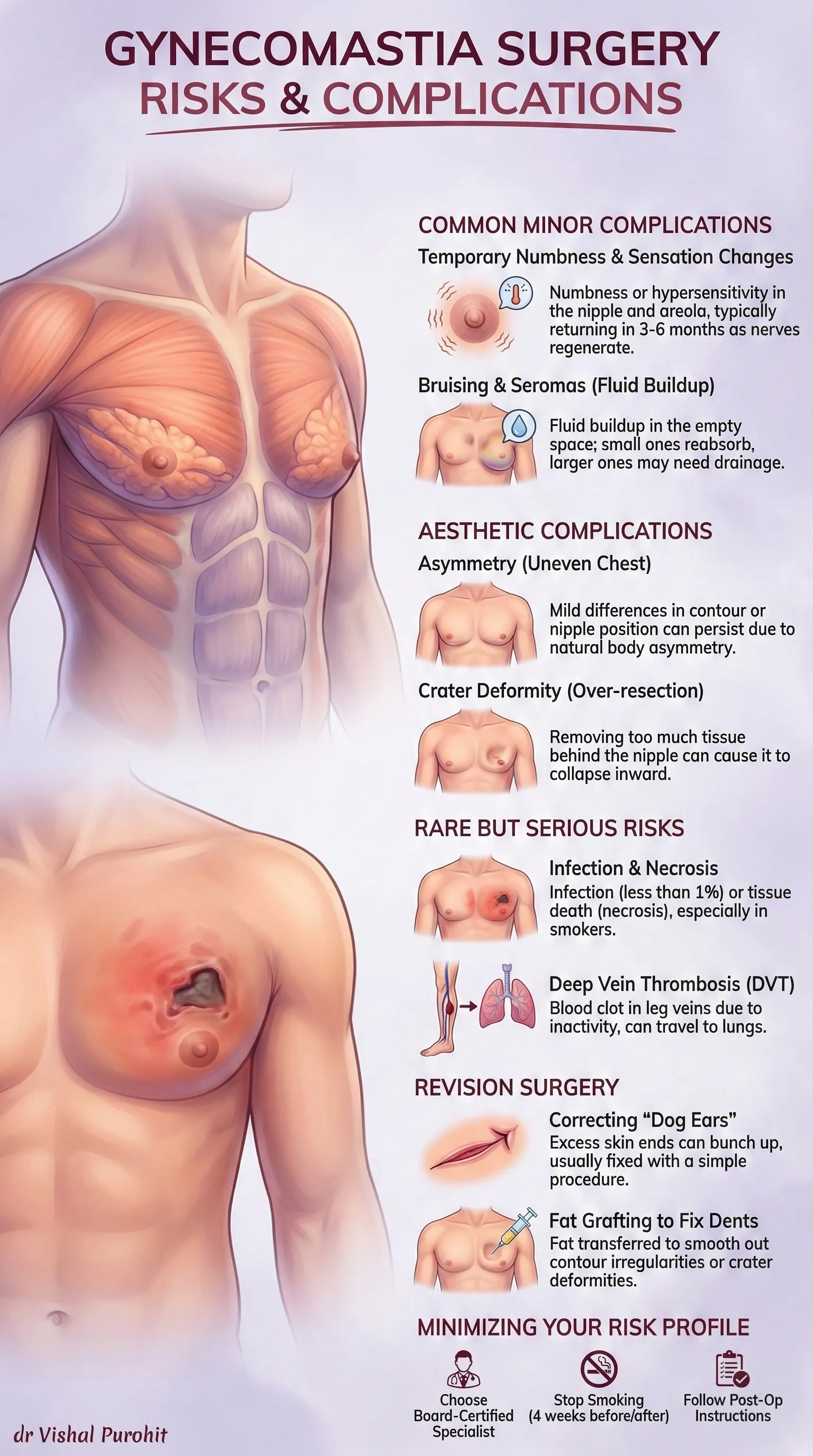
Temporary Numbness and Sensation Changes
During the surgery, the small sensory nerves in the chest skin are stretched or disrupted. It is very common to experience numbness (loss of feeling) or hypersensitivity (tingling/burning) in the nipple and areola.
- Timeline: Sensation typically returns gradually over 3 to 6 months as the nerves regenerate.
- Permanent Numbness: In rare cases (<1%), some loss of sensation may be permanent.
Bruising and Seromas (Fluid Buildup)
After tissue is removed, the body tries to fill the “empty space” with fluid. This is called a seroma.
- What it looks like: A soft, sloshing lump or unexpected swelling on one side.
- Treatment: Small seromas are reabsorbed by the body. Larger ones may need to be drained by your surgeon using a simple needle (aspiration).
Preventing this starts with your post-op routine. Read our guide on managing fluid buildup to see why wearing your compression vest is non-negotiable.
Hard Lumps (Scar Tissue)
About 3-4 weeks after surgery, you might feel hard, rubbery lumps under the skin. This is not the gland growing back. It is induration—internal scar tissue forming as the area heals. With regular massage and time, these lumps usually soften and disappear.
Aesthetic Complications
While safety is the priority, your goal is a good-looking chest. Aesthetic complications refer to results that are medically safe but visually unsatisfactory.
Asymmetry (Uneven Chest)
No human body is perfectly symmetrical. Your left pectoral muscle might be different from your right, or your rib cage might be slightly rotated. While surgeons strive for perfect symmetry, mild differences in contour or nipple position can persist post-surgery.
Crater Deformity (Over-resection)
This is arguably the most feared aesthetic risk. It occurs when a surgeon removes too much tissue directly behind the nipple.
- The Result: The nipple collapses inward and sticks to the chest muscle, creating a visible “dent” or saucer shape when you move your arms.
- Prevention: Skilled surgeons always leave a small “button” of tissue to support the nipple complex.
Saucer Deformity and Rippling
If liposuction is performed unevenly or too close to the skin surface, it can leave ridges, ripples, or a “washboard” appearance. This is more common in patients with poor skin elasticity.
Inverted Nipples
Internal scarring can sometimes pull the nipple inward (inversion). While often correctable, it can be distressing.
Rare but Serious Risks
True medical emergencies are incredibly rare in gynecomastia surgery, especially when performed in an accredited facility.
Infection and Necrosis
- Infection: Occurs in less than 1% of cases. It presents as spreading redness, intense heat, and fever. Antibiotics are prescribed prophylactically to prevent this.
- Necrosis: This is the death of skin tissue, usually the nipple. It happens if the blood supply is cut off. Smokers are at a much higher risk for this because nicotine constricts blood vessels.
Anesthesia Reactions
Modern anesthesia is very safe, but risks exist. Reactions can range from nausea and vomiting (common) to respiratory issues (rare). Your anesthesiologist will review your medical history to mitigate these risks.
Deep Vein Thrombosis (DVT)
A DVT is a blood clot forming in the leg veins due to inactivity. If it travels to the lungs (Pulmonary Embolism), it can be life-threatening.
- Prevention: Early walking (the day of surgery) and compression stockings are the best defense.
Revision Surgery
Sometimes, despite everyone’s best efforts, a second procedure is needed to perfect the results.
How Often is Revision Needed?
Global statistics suggest a revision rate of roughly 5% to 10%. This is often for minor tweaks rather than a full “redo.”
Correcting “Dog Ears”
In patients with loose skin, the ends of the incision can sometimes bunch up, creating a small pucker of skin known as a “dog ear.” This can usually be fixed with a simple in-office procedure under local anesthesia.
Fat Grafting to Fix Dents
If a crater deformity occurs, the surgeon may need to perform fat grafting—taking fat from another part of the body and injecting it into the dent to smooth out the contour.
Worried about the financial impact of a touch-up? Check our breakdown of the cost of revisions.
Minimizing Your Risk Profile
You can drastically lower your chances of complications by following three rules:
- Choose a Board-Certified Specialist: Ensure your surgeon specializes in male chest contouring, not just general breast surgery. The techniques are different.
- Stop Smoking: You must stop smoking or using nicotine products at least 4 weeks before and after surgery. Nicotine is the enemy of healing.
- Follow Post-Op Instructions: Wearing your garment, avoiding heavy lifting, and attending follow-ups are your responsibilities.
Conclusion
Risks are a reality of surgery, but they are manageable. The vast majority of gynecomastia patients experience a smooth recovery and are thrilled with their results. The key is to choose a surgeon who prioritizes safety and precision over speed or low cost.
Want to discuss your safety concerns? We believe in total transparency. Contact Dr. Vishal Purohit to have an honest conversation about your risk factors and how we mitigate them.
Call or WhatsApp: +91 77181 83535